

In the landscape of global health, few disparities are as stark as the gap in maternal and neonatal care. According to data from the World Health Organization (WHO), approximately 287,000 maternal deaths and 2.4 million neonatal deaths occur annually, with a staggering 95% of these tragedies concentrated in under-resourced settings. Often, these outcomes are not the result of untreatable conditions, but rather the result of a lack of early detection.
Now, a team of researchers at Google, led by Angelica Willis and Akib Uddin, is working to fundamentally change this trajectory. By leveraging the power of TensorFlow Lite—Google’s open-source framework for running machine learning on mobile devices—the team is developing AI-driven ultrasound tools designed to function in the most remote corners of the globe.
The Core Challenge: A Global Shortage of Expertise
Traditional obstetric diagnostics rely heavily on ultrasound to determine gestational age and fetal presentation—crucial metrics for monitoring the health of the birthing parent and fetus. When a fetus is in a breech position or a pregnancy is reaching a high-risk stage, early identification allows healthcare providers to intervene before complications escalate.
However, performing and interpreting an ultrasound is a highly specialized skill. It requires years of training and experience. In many rural or underserved regions, there is a profound shortage of trained sonographers. Consequently, it is estimated that nearly two-thirds of pregnant individuals in these settings do not receive a single ultrasound screening throughout their entire pregnancy. While advancements in sensor technology have made portable, smartphone-integrated ultrasound devices more affordable, the "human capital" barrier—the need for a skilled operator—remains the primary obstacle to widespread adoption.

A Chronology of Innovation: From Research to Reality
The development of this technology did not happen overnight. It is the result of a multi-year effort that bridged the gap between advanced deep learning and practical, field-ready hardware.
- Initial Conceptualization: The Google Research Health AI team identified that the bottleneck was not the hardware, but the proficiency required to navigate the human abdomen to capture diagnostic-quality images.
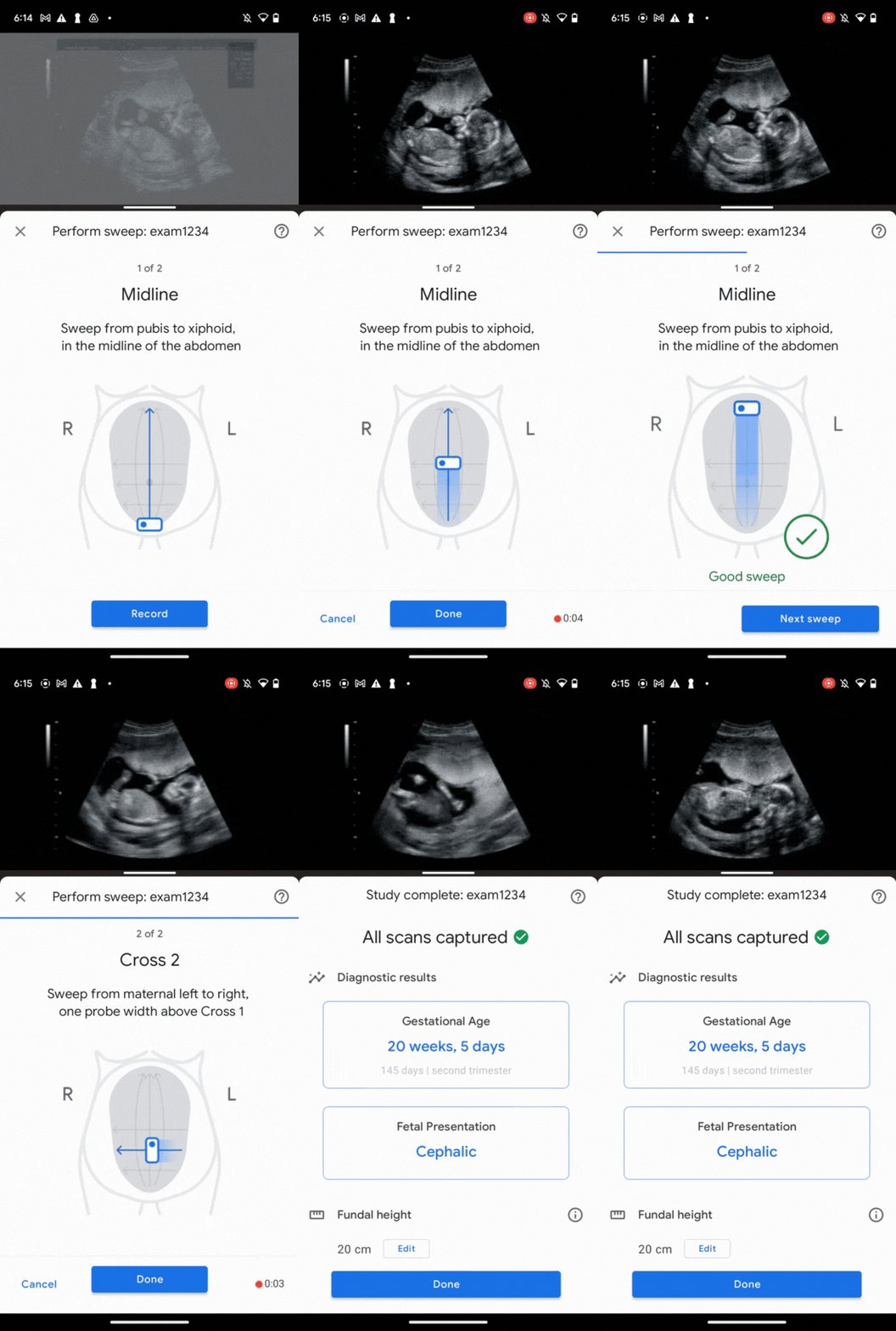
- The "Blind Sweep" Breakthrough: The researchers moved away from requiring precise, expert-led image capture. Instead, they developed a "blind sweep" protocol. In this method, a non-expert health worker simply moves the ultrasound probe across the patient’s abdomen in a systematic, sweeping motion.
- Model Training: Using datasets from clinical partners, the team trained models to interpret these "blind" video feeds. The AI identifies key anatomical landmarks within the noisy, raw video data, effectively "seeing" what an expert would see.
- Optimization via TensorFlow Lite: With the core models validated, the team focused on deployment. Because their target environment often lacks reliable electricity and high-speed internet, the models had to be optimized to run entirely on-device. By utilizing TensorFlow Lite, the researchers successfully compressed these complex models, allowing them to run on standard mobile hardware without sacrificing accuracy.
Supporting Data: Validating the AI’s Precision
The efficacy of this technology is not merely theoretical. In a recent study published in Nature Communications Medicine, titled "A mobile-optimized artificial intelligence system for gestational age and fetal malpresentation assessment," the team presented data demonstrating that their AI-enabled approach matches the standard of care performance.
When comparing their blind-sweep-based gestational age regression model to traditional biometry performed by experts, the AI achieved high levels of accuracy. The study, which included 407 participants for age assessment and 623 for malpresentation classification, showed that even when the scans were performed by novices, the AI could extract the necessary information to provide clinically actionable data.
Furthermore, the optimization process provided a 2x boost in execution speed using the TensorFlow Lite GPU delegate. This allows for real-time inference at more than 30 frames per second on common mobile devices, enabling the system to provide instant feedback. If a scan is of poor quality, the app immediately prompts the user to adjust their technique—perhaps by applying more pressure or adding more gel—creating a "closed-loop" learning system for the health worker.

Official Perspectives: The Ethics of AI in Healthcare
The development of this technology is governed by Google’s rigorous AI Principles, which emphasize social benefit, safety, and accountability. The team has been careful to frame the tool as a decision-support system, not a replacement for clinical judgment.
"Our vision is to enable safer pregnancy journeys using AI-driven ultrasound that could broaden access globally," the research team stated in their official project release. By focusing on on-device ML, they have also addressed one of the most critical concerns in modern healthcare: data privacy. Because the processing occurs entirely on the local device, sensitive patient data never needs to leave the handset or be uploaded to the cloud, ensuring that privacy is maintained even in regions with minimal digital infrastructure.
The project has also benefited from key academic and clinical partnerships. By collaborating with the Department of Obstetrics and Gynaecology at the University of Zambia School of Medicine and the University of North Carolina School of Medicine, the researchers have ensured that the technology is tested against the real-world conditions of the environments it intends to serve.
Implications: A New Era for Maternal Health
The implications of this technology are far-reaching. If scaled successfully, the "blind sweep" protocol could transform community health workers—who are often the backbone of rural health systems—into competent providers of essential prenatal diagnostics.

1. Reducing Preventable Mortality
By enabling early detection of complications such as fetal malpresentation or growth restriction, healthcare systems can move from a reactive model to a proactive one. Many of the 2.4 million annual neonatal deaths could be prevented if providers simply knew when a high-risk birth was imminent.
2. Technological Democratization
The use of TensorFlow Lite proves that cutting-edge AI does not require supercomputing power. By optimizing for edge devices, Google is demonstrating that the "digital divide" does not have to be an insurmountable barrier to medical progress. This approach can be extended to other diagnostic fields, from dermatology to ophthalmology.
3. Strengthening Partnerships
The ongoing collaboration with organizations like Jacaranda Health in Kenya highlights the necessity of localized implementation. Technology alone cannot solve the global maternal mortality crisis; it must be integrated into existing clinical workflows and supported by local training initiatives.
Looking Ahead
As this research moves from the prototype phase toward potential real-world implementation, the challenges ahead remain significant. Regulatory approval, hardware distribution, and the creation of sustainable training programs for healthcare workers are the next hurdles.

However, the progress made by the Google Research team serves as a beacon of what is possible when deep learning is applied to humanitarian ends. By shrinking the complexity of ultrasound into a mobile application, the team is not just writing code; they are effectively expanding the reach of the hospital, ensuring that a pregnant person in a rural village has the same opportunity for a safe delivery as one in a major metropolitan center.
In the words of the research team, this is only the beginning. With the continued support of international health partners and the ongoing refinement of on-device AI, the goal of universal access to prenatal diagnostics is moving from a distant aspiration to a tangible, reachable reality.
Disclaimer: TensorFlow Lite has not been certified or validated for clinical, medical, or diagnostic purposes. Users of such technologies are solely responsible for their application and the independent validation of any outputs generated.
